



The Climate Innovation Center is one of the highest-performance, zero-emission buildings in the nation. In June 2026, it officially achieved both Zero Carbon Certification™ and Zero Energy Certification™ through the International Living Future Institute.
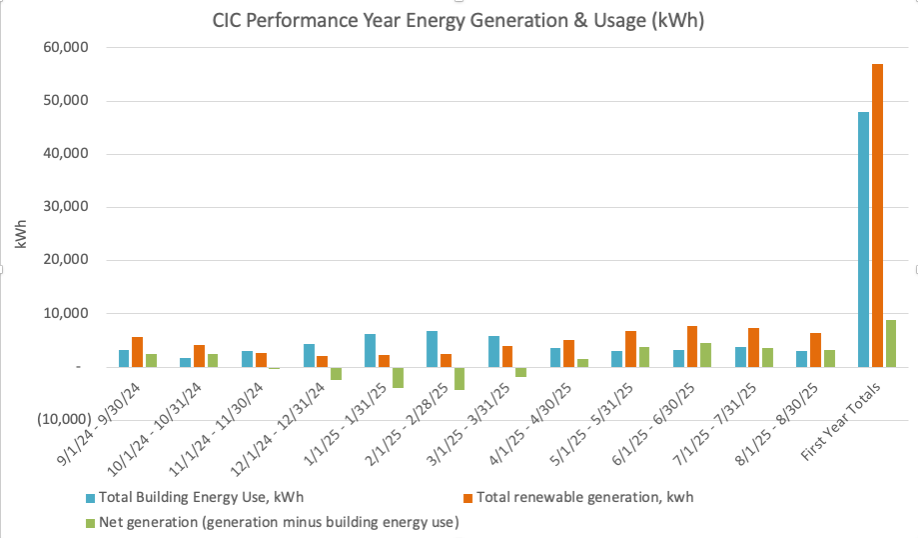
To earn these certifications, Utah Clean Energy was required to measure solar generation and electricity consumption for at least 12 months to demonstrate the building produces all of the energy it needs using clean, solar power. After this first full year of performance, utility bills and solar generation reports confirmed that the Climate Innovation Center is achieving this goal and them some. Over the course of the year, the building generated 8,906 kilowatt-hours more clean electricity than it consumed, even when accounting for charging staff members’ electric vehicles. That surplus is enough clean energy to power nearly eight average EVs for an entire year. To achieve Zero Carbon Certification™, we also had to measure and report on the reduction in embodied carbon from our project following the Zero Carbon program guidance. The analysis reported a staggering 98% reduction in embodied carbon for the Climate Innovation Center as compared to building from scratch using standard building materials.
Key Considerations
November through March are low sunlight months when we generate less electricity than we use in our fully electric building. This will continue to be the case moving forward but we hope the difference won’t be quite as much as we continue to optimize the mechanical systems in the building.
What have we learned? Advanced heat pump systems are optimized if you “set it and forget it”. We didn’t do this for November through January because it is so counter-intuitive to leave the heat pump system at the same set points during the workdays, overnight, and all weekend. But initial data shows that the demand spikes became much smaller after we removed evening and weekend setbacks in late January. This is very important for any building that pays demand charges for their utility rate schedule, and to minimize a building’s grid impacts.
During the month of April, we would have generated about 900 kWh more electricity than represented on this graph due to a solar inverter problem. What have we learned? The faster a building owner/operator notices and addresses solar system malfunctions, the better! We realized we need to check the solar system performance more systematically and more frequently.
What about our battery? The battery allows us to store electricity on site and use it when the sun is not available or if the power goes out. We have had brief power outages where the battery has performed as expected but we have not had any extended outages as of yet. The battery should also be capable of peak shaving (reducing demand from the grid) but it seems this is difficult during the winter when the battery is used more due to less solar generation.
What have we learned? A battery and how it is set and performs, is not simple. Conceptually it just stores electricity, but in practice, there is a lot going on, not all of which is intuitive. We are looking forward to better transparency on our system once our energy management system is up and running.
Into the future, we’ll continue to monitor whole building energy use and closely track system level electricity consumption through our internal building energy dashboard, which allows us to monitor 15-minute data by end-use category, including mechanical system, lighting, plug loads, water heating, and EV charging. This energy performance dashboard will help us better monitor how the Center is using energy and further optimize energy performance.
Our kitchen composting bin is part of a sustainable system through Momentum Recycling, which collects food waste and transports it to the Wasatch Resource Recovery facility. Instead of sending food scraps to a landfill where they rot and emit harmful methane gas, our waste is processed in an anaerobic digester that captures and converts these gases into “renewable natural gas”. This gas is then fed into municipal gas lines where Wasatch Resource Recovery will use it to provide enough gas for approximately 40,000 people according to Momentum Recycling. Additionally, the remaining byproduct is turned into nutrient-rich fertilizer for local farms. This system not only reduces greenhouse gas emissions but also conserves landfill space and supports a circular, sustainable food and energy economy.
In addition to recycling glass, plastics, aluminum, paper, and cardboard, staff and visitors at the Climate Innovation Center can recycle plastic food and candy wrappers in our Zero Waste Box from Terracycle.

